


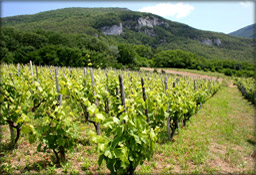
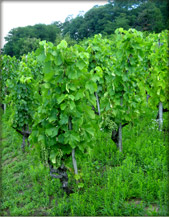
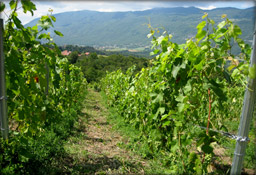
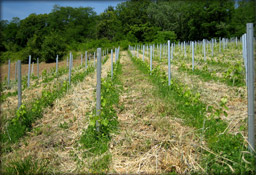
 Our 60- to 80-year-old vines are grown in the shape of a gobelet. No weed-killers are used for they are entirely grassed over and scythed mechanically. The earth between the vines was sown with legumes (luzerne) to bring naturally produced nitrogen to the soil and contains a wide variety of indigenous plants which spontaneously grow among wild grapes. The soil is worked by earthworms and micro-organisms including bacteria, yeasts and microscopic algae, which we nurture with mulch. Planting stands at 10,000 vines per hectare.
The number of phytosanitary treatments is kept to a minimum (5-6 a year). Our agricultural practices are reasoned and we only treat our crops when it is absolutely necessary.
New plantations. Our vines are grown in small plots especially well oriented to catch the sun and in propitious soils, cultivated since the Roman era. In order to preserve the soil’s characteristic features, the actual structure of the soil is not damaged by deep-ploughing which brings to the surface the deeper layers of the soil and buries the topsoil, thereby breaking up the layers and completely upsetting the micro-organisms and other creatures that live in the soil and participate in its delicate balance. The facing photograph shows bird’s-foot-trefoil (Lotus corniculatus) sown at the foot of the vines (see Our cultivation methods).
Planting density: 9,000 vines per hectare.
|
|
White Molette variety
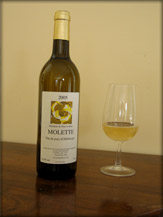 Our Molette vines were destined to be pulled out: we chose to keep them and take up the challenge presented by this rare and tough variety. Its name derives from the French adjective mou/molle, or tender, and indeed its flesh is very tender. It is close to the gringet variety (personal communication J.-F. Vouillamoz, 2008). Molette is virtually only grown in the area around Seyssel. Although it presents interesting qualities, in particular the fine aromatic character of its grapes, it is less and less frequently planted and grown. The wine’s aroma is both fruity and floral and it is fresh and well-balanced. Its colour is basically a bright straw-yellow with hints of Chartreuse green. Its fresh aromas make it a good choice for aperitifs, fresh-water fish, seafood or even fondue.
Our production criteria are stricter than those of the local Vin de Pays. Our yield is low (0.5 litres/ sq m). The presence of SO2 is negligible, some <70 mg/l (as against the authorized 210 mg/l), because the grapes are carefully selected, and any berry one would not like to eat is rejected. Pre-bottling filtering is minimal (not sterile), to avoid any heaviness in the finish. We do not practice malolactic fermentation (unless it is absolutely necessary), because it can break the characteristic aromas if it is not well-managed and can introduce buttery-milky aromas.
The nose will pick up definite hints of grape-flowers and pineapple (no aromatic oddities). The wine’s finish is long-lasting with good structure (its aromas linger for more than 10 seconds). It is not tannic, owing to the fact that the stalks are removed before the grapes are pressed. While its acidity is fresh and lively there is no volatile acidity, neither is there any residual sugar (its presence usually indicates that the grapes were harvested before they were ripe).
Mondeuse noire variety (procyanidin content: five hearts  )
)
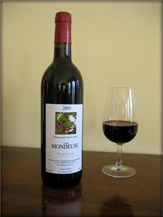 This variety is well-suited to the alpine climate and produces a well-structured red wine, dense, with black berry and spicy aromas. In a recent study, José F. Vouillamoz showed by DNA tests that “Mondeuse blanche” has a parent-offspring relationship with both “Mondeuse noire” and “Viognier”. The “Mondeuse blanche” plays a key part in the origin of the important vines from the east of France (“Syrah”, “Viognier” and “Mondeuse noire”). Thus, Vouillamoz demonstrated that “Mondeuse noire” can be: 1) grandparent with “Syrah” and “Viognier”, 2) granddaughter with “Viognier” and half-sister with “Syrah” or still 3) half-sister with “Syrah” and with “Viognier”.
Source from : « Mondeuse noire » et « Viognier » dans l’arbre généalogique de la « Syrah ». José F. Vouillamoz in First International Symposium on Syrah (Lyon- France 13-14 mai 2008).
In the United States, Mondeuse noire is often known as “Refosco”, however it does not appear to have any links with the Italian Refosco.
Very recent analyses of our Mondeuse noire has shown that it presents similar amounts of procyanidins to those contained in the Madiran wines (Tannat variety) and the Italian Sagrantino variety, known to be the among the world’s richest in procyanidins and therefore the most likely to help fight heart disease. All our Mondeuse noire wines received the maximum score of five hearts from professor Roger Corder who is well-known for coming up with the best evidence to explain the French Paradox (see Wine and Health).
Quantity of procyanidins:
Mondeuse noire 2004 : 1.03 g/LThe tightly packed, oval, dark blue bordering on black grapes ripen late, in the first half of October. Their flesh is melting and juicy, their skin astringent and pungent. The wine is robust, strong, aromatic and spicy with good tannins. It matures well (it can be kept more than 5 years).
Mondeuse noire 2005 : 1.40 g/L
Mondeuse noire 2006 : 1.65 g/L
Mondeuse noire 2007 : 1.07 g/L
Mondeuse noire is an AOC Savoie wine; our production criteria are however stricter than those of the AOC (Appellation d’Origine Contrôlée). The average yield stands at 0.35 to 0.4 litres per vine. The SO2 concentration is very low, < 50mg/l (as against the authorized 160 mg/l because only perfect grapes are used and the rest discarded.
Mondeuse noire is a deep ruby-red (good extraction of anthocyane pigments), luminous (low level of particles in suspension). It contains the frank aromas of its grapes (no aromatic oddities), with slight spicy and peppery notes. Mondeuse noire’s finish is powerful and lingering, with assertive but not aggressive tannins and good acidity. It sports a strong body with very low volatile acidity and no residual sugars. Our Mondeuse noire is rich in polyphenols (tannins and flavonoids, anthocyans, catechins which are powerful antioxidants. Much research has shown them to be beneficial to our health.
Mondeuse noire is a good companion to red meats and cheese.
Gamay noir variety
Widely grown, especially in the Beaujolais area, Gamay needs no introduction. It is also very popular among Savoie wine-growers.
Our vines are between 30 and 60 years old, and are grown in such a way that they produce very small quantities of grapes. The harvest is carefully picked over, the grapes removed from the stalks and all the damaged fruit is discarded. The wine is produced in small quantities, virtually without oxygenation. This results in a dark ruby, concentrated and peppery wine, quite unlike the Gamay usually produced in the area. Our gamay was given 3 hearts () concerning the level of procyanidins from prof. Roger Corder (see below “Wine and Health”).
Altesse or Roussette variety
This white variety is also widely grown in the area and is locally known as Roussette. It produces a rich, aromatic and fresh wine, but will not be grown on the Vens-le-Haut estate in the immediate future.
Alcohol can be bad for your health and should only be drunk in moderation.

